
Composite Decking Wirral: A Complete Guide to Modern Outdoor Decking
Composite Decking Wirral established 2008 and based in the middle of the Wirral, cover all of Merseyside, particularly Liverpool, Chester, North Wales and beyond. We are always striving to exceed our customers expectations, and go the extra mile.
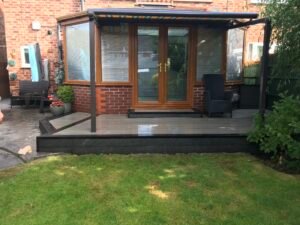
Mark McCabe our founder is forever researching the best products and processes for installations of composite decking and looking at Composite Garden Rooms Technology, to implement more efficient insulation and heating systems.
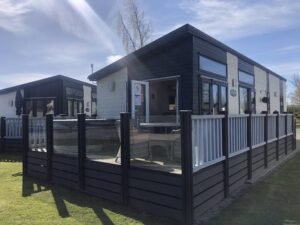
Composite Decking Wirral have recently joined up with a glass balustrade manufacturer to provide beautiful glazed balustrades to compliment the composite decking. This is very popular with caravan surrounds to keep the beautiful vistas to a maximum.

Composite decking has become one of the most popular ways to create attractive, practical outdoor living spaces across Wirral. From contemporary garden renovations in Heswall and West Kirby to family gardens in Birkenhead, Bromborough, Greasby and Bebington, more homeowners are looking for alternatives to traditional timber decking that require less maintenance and continue to look good throughout the year.
For anyone considering composite decking in Wirral, it is useful to understand where the product came from, how it differs from timber, what it is made from and why it is particularly well suited to the weather conditions found across the Wirral Peninsula.
Composite decking is not simply plastic decking. Modern boards are engineered products designed to combine the appearance of timber with increased resistance to moisture, rot, staining and everyday wear. The quality of composite products has also improved considerably over the years, giving homeowners a much wider choice of colours, textures and finishes than was previously available.
This guide looks at the background of composite decking, how it developed, its advantages and disadvantages, and what Wirral homeowners should consider before deciding whether it is the right option for their garden.
What Is Composite Decking?
Composite decking is an engineered decking material usually manufactured using a combination of wood fibres and recycled or synthetic plastics.
Instead of cutting a decking board directly from a tree, manufacturers blend the different materials together and form them into boards. The result is a decking product designed to reproduce the appearance and texture of timber while reducing some of the maintenance problems traditionally associated with wooden decking.
Depending on the manufacturer and product range, composite decking may contain recycled wood flour, sawdust, polyethylene, polypropylene or other polymers. Colour pigments, stabilisers and protective additives may also be included during manufacturing.
The exact construction varies considerably between brands.
Some boards are solid, while others use a hollow or cellular structure to reduce weight and material consumption. Premium composite decking is often manufactured with a protective outer layer known as a cap or shell. This additional surface helps protect the board against moisture, staining, fading and general wear.
These products are often described as capped composite decking.
The Background and Development of Composite Decking
Traditional timber has been used for decking, boardwalks, terraces and raised outdoor areas for generations. It is readily available, relatively easy to work with and provides the natural appearance many homeowners want.
However, timber also has limitations.
Once installed outdoors, wooden boards are continually exposed to moisture, sunlight, temperature changes, organic growth and insects. Without suitable treatment and maintenance, timber can discolour, crack, warp or eventually decay.
Homeowners may also need to clean, stain, paint or oil wooden decking periodically to preserve its appearance.
The search for a lower-maintenance alternative led manufacturers to experiment with combinations of wood particles and plastic materials during the latter part of the twentieth century.
Wood-plastic composites were already being developed for various industrial purposes, but the technology eventually became particularly suited to decking.
Early composite decking products often had a fairly obvious artificial appearance. Colours were limited, wood-grain effects were relatively basic and some early-generation boards suffered from staining or fading.
As manufacturing methods improved, the products changed considerably.
Manufacturers developed more realistic grain patterns, improved UV protection, better colour stability and more sophisticated surface coatings. Modern boards can now reproduce the appearance of hardwoods, weathered timber and contemporary architectural finishes surprisingly effectively.
This development has helped turn composite decking from a specialist alternative into a mainstream landscaping product.
Why Composite Decking Has Become Popular in Wirral
The Wirral climate is one reason composite decking can make sense for local gardens.
The peninsula experiences the typical conditions associated with north-west England: periods of rain, damp winters, changing temperatures and relatively limited stretches of consistently dry weather.
These conditions are not necessarily kind to untreated outdoor timber.
Timber repeatedly absorbs and releases moisture as conditions change. Over time, this can contribute to movement, splitting, surface deterioration and organic growth.
Composite decking does not behave in exactly the same way.
Because a significant proportion of the board is polymer-based, it generally absorbs considerably less water than ordinary timber. High-quality capped boards provide an additional barrier against moisture penetration.
That does not mean composite decking is maintenance-free, and it certainly does not mean that poor installation can be ignored. Drainage, airflow and the quality of the supporting structure remain extremely important.
Nevertheless, reduced moisture absorption is a significant advantage in gardens where decking may remain damp for extended periods.
The Rise of Outdoor Living
Another reason for the popularity of composite decking in Wirral gardens is the changing way homeowners use their outdoor space.
The garden is increasingly viewed as an extension of the home rather than simply an area containing a lawn and flowerbeds.
Decking can create a clearly defined area for outdoor dining, entertaining, barbecues, garden furniture or simply sitting outside during warmer weather.
It can also help overcome differences in garden levels.
For example, a property with patio doors positioned above the surrounding ground level may benefit from a raised decking platform, creating a smoother transition between the house and garden.
Composite decking works particularly well for contemporary designs because hidden fixing systems can create a cleaner finish than traditional screw-fixed timber boards.
The boards can also be combined with artificial grass, porcelain paving, decorative aggregates, rendered walls, garden rooms and modern fencing to create a complete garden transformation.
Composite Decking Versus Traditional Timber Decking
One of the biggest decisions homeowners face is choosing between composite and timber.
Timber usually has a lower initial material cost. For customers working with a limited budget, treated softwood decking can therefore remain an attractive option.
Natural timber also has a character that manufactured products cannot reproduce completely. Every wooden board has naturally occurring differences in grain, knots and colour.
Composite decking takes a different approach.
Its greatest advantage is convenience.
Once properly installed, it does not normally require the repeated staining, painting or oiling associated with many timber decks. Routine maintenance generally consists of removing debris and periodically washing the surface.
Composite boards are also manufactured to provide greater consistency. The colour and profile remain relatively uniform throughout an installation, which can suit contemporary garden designs.
The trade-off is a higher initial purchase price.
However, the long-term comparison should take maintenance into account. Brushes, cleaners, wood treatments, replacement boards and the homeowner’s time all contribute to the real cost of maintaining a timber deck.
For many homeowners, the decision therefore comes down to whether they prefer a lower upfront cost or reduced ongoing maintenance.
What Does Composite Decking Look Like?
Modern composite decking is available in a much wider selection of designs than many people realise.
Grey remains particularly popular because it complements contemporary properties and works well alongside porcelain paving and modern garden furniture.
Brown and oak-effect boards provide a more traditional appearance, while darker charcoal and black finishes can create a strong architectural look.
Some ranges reproduce exotic hardwood colours.
The surface texture also varies.
Entry-level products may use a relatively simple repeating wood-grain pattern. More expensive boards can feature deeper embossed grain, multi-tonal colour variation and less obvious repetition.
Reversible boards are also available, with one texture on each side.
When choosing decking, viewing a physical sample is extremely useful. Colours can appear very different on a computer or phone screen compared with natural daylight.
It is also worth viewing several boards together. A single sample cannot always demonstrate how colour variation will appear across an entire deck.
Capped and Uncapped Composite Decking
Understanding the difference between capped and uncapped decking can help homeowners compare quotations properly.
Traditional or first-generation composite boards are manufactured from the composite material throughout and have no separate protective outer coating.
Capped composite boards include an additional polymer layer around some or all of the board.
This protective layer is designed to improve resistance to staining, moisture and fading.
For gardens used regularly for entertaining, eating outdoors, children or pets, capped decking can therefore be particularly attractive.
Food, drinks, mud and everyday garden dirt are inevitable on a frequently used outdoor surface.
No decking material is completely immune to marks, but a quality protective shell generally makes cleaning easier.
Is Composite Decking Slippery?
This is an important question, particularly in the Wirral climate.
Any outdoor surface can become slippery when contaminated with algae, moss, leaves or other organic matter. Composite decking is no exception.
The slip resistance of composite boards depends greatly on their surface texture and individual product specification.
Some products are specifically manufactured with improved slip-resistant surfaces.
Good maintenance also makes a considerable difference. Leaves and debris should not be allowed to remain on the decking for long periods, particularly during autumn and winter.
Drainage is equally important.
Water should be able to leave the deck efficiently rather than collecting around or underneath it.
Customers concerned about slip resistance should compare manufacturer testing rather than assuming all composite boards perform equally.
The Importance of the Subframe and Professional Fitters
Homeowners naturally focus on the visible decking boards, but the structure underneath them is just as important.
Decking is only as good as the base supporting it.
A typical installation requires a properly designed subframe with adequate support, correct joist spacing and sufficient ventilation.
Depending on the project, the structure may use treated timber, composite joists or aluminium.
The appropriate choice depends on the height of the deck, ground conditions, expected loads and manufacturer’s installation requirements.
If timber is used underneath an expensive composite deck, it should be appropriate for the environment and installed to minimise prolonged moisture exposure.
The ground beneath the structure must also be considered.
Simply constructing decking over soft, unstable or poorly drained ground can lead to movement later.
A professional installation should therefore consider the entire construction rather than simply calculating how many decking boards are required.
Drainage Matters in Wirral Gardens
Drainage deserves particular attention locally.
A deck should not be treated as a solution for an unresolved waterlogging problem.
If an area regularly holds standing water, the underlying drainage problem needs to be understood before decking is installed.
Depending on the site, preparation might involve improving falls, installing drainage, excavating unsuitable material or modifying the sub-base.
Deck boards themselves also require appropriate expansion gaps and spacing according to the manufacturer’s instructions.
These gaps allow drainage and accommodate natural thermal movement.
Composite materials expand and contract as temperatures change. Incorrect spacing can therefore cause problems even though the boards do not behave exactly like timber.
Composite Decking Around Artificial Grass
One particularly effective garden design involves combining artificial grass and composite decking.
The two materials serve different purposes.
Artificial grass creates a softer open area suitable for children, pets and general garden use, while decking creates a defined hard-standing area for seating and furniture.
A deck immediately outside patio or bi-fold doors can lead down to an artificial lawn, helping divide the garden into functional zones.
The colours should be selected together rather than independently.
For example, a deep charcoal deck can create a strong contrast against bright artificial grass, while oak or brown decking may provide a softer and more traditional appearance.
Good edging between the materials is important because it gives the installation a deliberate, finished appearance.
Composite Decking for Family Gardens
Composite decking can be particularly suitable for busy family gardens because it removes much of the routine maintenance associated with timber.
There is no annual staining schedule and no peeling paint to deal with.
Many modern boards are also designed to minimise splintering, making them attractive for families where children frequently use the garden barefoot.
However, homeowners should remember that dark-coloured decking can become warm in strong sunlight.
This is worth considering when choosing both colour and location, particularly for south-facing gardens.
Furniture placement and shaded areas can help create a more comfortable space during hot weather.
Composite Decking and Dogs
Pet owners are increasingly interested in low-maintenance landscaping.
Composite decking can work alongside dog-friendly artificial grass to create a practical outdoor environment.
The non-porous or low-absorption nature of capped composite boards can make them easier to clean than untreated timber.
However, pet areas still require routine hygiene.
Urine, mud and other contamination should be washed away rather than left on the surface.
Decking should also be designed so that water can drain effectively underneath it.
A poorly ventilated deck with trapped organic material beneath the boards can create odour problems regardless of what the visible decking is made from.
How Long Does Composite Decking Last?
The lifespan of a composite deck depends on product quality, installation and use.
Many reputable manufacturers offer lengthy residential warranties, sometimes extending over several decades.
A warranty should not be confused with a guaranteed service life, but it can indicate the manufacturer’s confidence in the product.
Installation conditions are critical.
Incorrect joist spacing, insufficient ventilation, inadequate expansion gaps or an unstable subframe can reduce the performance of even high-quality boards.
This is why homeowners comparing composite decking quotations should consider more than the price per square metre.
The specification underneath the deck is equally important.
Does Composite Decking Fade?
All materials exposed to sunlight undergo some degree of weathering.
Modern composite decking typically contains UV stabilisers designed to reduce fading, and premium capped products usually perform considerably better than older composite materials.
Some initial colour change may occur after installation as the boards weather naturally.
Manufacturers often explain the expected level of colour stabilisation in their technical literature.
Very cheap products may offer less predictable colour stability, which is another reason to compare specifications and warranties carefully.
Is Composite Decking Environmentally Friendly?
Composite decking is frequently promoted on environmental grounds because many products incorporate recycled plastic and reclaimed wood fibres.
This can help divert materials from the waste stream and reduce the demand for virgin timber.
However, environmental claims should be considered carefully.
The percentage of recycled content varies between manufacturers, and composite decking itself combines materials that can be difficult to separate.
Customers interested in sustainability should look for clear information from the manufacturer about recycled content, manufacturing processes, product lifespan and end-of-life recycling.
Durability is also part of the environmental calculation.
A product that remains functional for many years without repeated chemical treatments or frequent replacement may offer advantages over a shorter-lived alternative.
Choosing Composite Decking in Wirral
Homeowners considering a new deck should avoid selecting a product solely because of colour or price.
The board specification, subframe, fixings, drainage and installer experience all matter.
Before proceeding with a project, it is sensible to consider the following factors:
- whether the deck will be raised or installed close to ground level;
- how rainwater will drain from the area;
- whether the garden suffers from existing waterlogging;
- the amount of direct sunlight the deck receives;
- whether children or pets will regularly use the area;
- slip resistance;
- board warranty and manufacturer reputation;
- the type of subframe being proposed;
- access for construction and waste removal;
- how the decking will connect with paving, artificial grass, steps, doors and other garden features.
A properly planned installation should answer these questions before work begins.
Composite Decking Across the Wirral Peninsula
One of the advantages of composite decking is its versatility.
A small courtyard garden in Birkenhead may require a very different design from a large detached property in Heswall or Caldy.
Properties in West Kirby and Hoylake may favour contemporary coastal-inspired designs, while established gardens in Greasby, Pensby or Thingwall may require decking that blends more subtly with existing landscaping.
In Bromborough, Bebington, Prenton and Wallasey, decking can be particularly useful where homeowners want to create a defined entertaining area without paving the entire garden.
There is no single correct design.
The best installations respond to the property, garden levels, drainage conditions and way the customer intends to use the space.
The Future of Composite Decking
Composite decking technology continues to evolve.
Manufacturers are investing in more realistic grain patterns, improved slip resistance, better protective coatings and increased use of recycled materials.
There is also growing interest in aluminium subframes and complete decking systems designed to improve longevity beneath the visible boards.
For homeowners, this means the gap between traditional timber and composite decking is likely to continue widening in terms of maintenance requirements.
Timber will always have an important place in landscaping because of its natural character and relatively low initial cost.
Composite decking, however, offers something different: a consistent, contemporary outdoor surface designed around convenience and long-term performance.
Is Composite Decking Worth It?
Whether composite decking represents good value depends on what the homeowner wants from the garden.
If the priority is achieving the lowest possible initial cost, traditional timber may remain the preferred option.
If the priority is creating a smart outdoor area with reduced ongoing maintenance, composite decking becomes extremely attractive.
For many Wirral households, the biggest benefit is simply being able to enjoy the deck without repeatedly sanding, staining or treating it.
A well-designed composite deck can create a natural transition from house to garden, provide space for furniture and entertaining, and complement artificial grass, paving and other modern landscaping features.
The key is quality.
Good boards installed badly can still produce a poor result. Likewise, an excellent installation using an unsuitable low-quality product may disappoint over time.
Product and installation therefore need to be considered together.
Composite Decking Wirral: Creating a Garden for Modern Living
The rise of composite decking in Wirral reflects a broader change in garden design.
Homeowners increasingly want outdoor spaces that look attractive throughout the year but do not require constant maintenance.
Composite decking answers many of those requirements.
It offers the warmth and visual character associated with timber while providing improved resistance to some of the problems created by moisture, staining and ongoing weather exposure.
For Wirral gardens, where decking must cope with regular rainfall and changing conditions, those characteristics can be particularly valuable.
When combined with careful groundwork, good drainage, a properly constructed subframe and professional installation, composite decking can form the centrepiece of a complete garden transformation.
Whether the project involves a small seating platform, a large entertaining deck, steps leading into the garden or a combination of decking and artificial grass, careful planning will determine the quality of the finished result.
The most important advice is not simply to search for the cheapest boards.
Look at the entire system.
Consider where the water will go, what supports the decking, how the boards are fixed, what warranty is provided and how the area will actually be used.
Done properly, composite decking can provide a clean, modern and practical outdoor space that complements both contemporary and traditional homes across the Wirral Peninsula.
For homeowners researching Composite Decking Wirral, the technology has now reached a point where there is a broad choice of realistic colours, durable surfaces and installation systems to suit many different types of property. Understanding the product and investing in correct preparation is the best way to ensure that the finished deck remains an attractive and useful part of the garden for years to come.
Click here to view our Composite Decking Wirral Free Cost Calculator.


