
Composite Decking Birkenhead
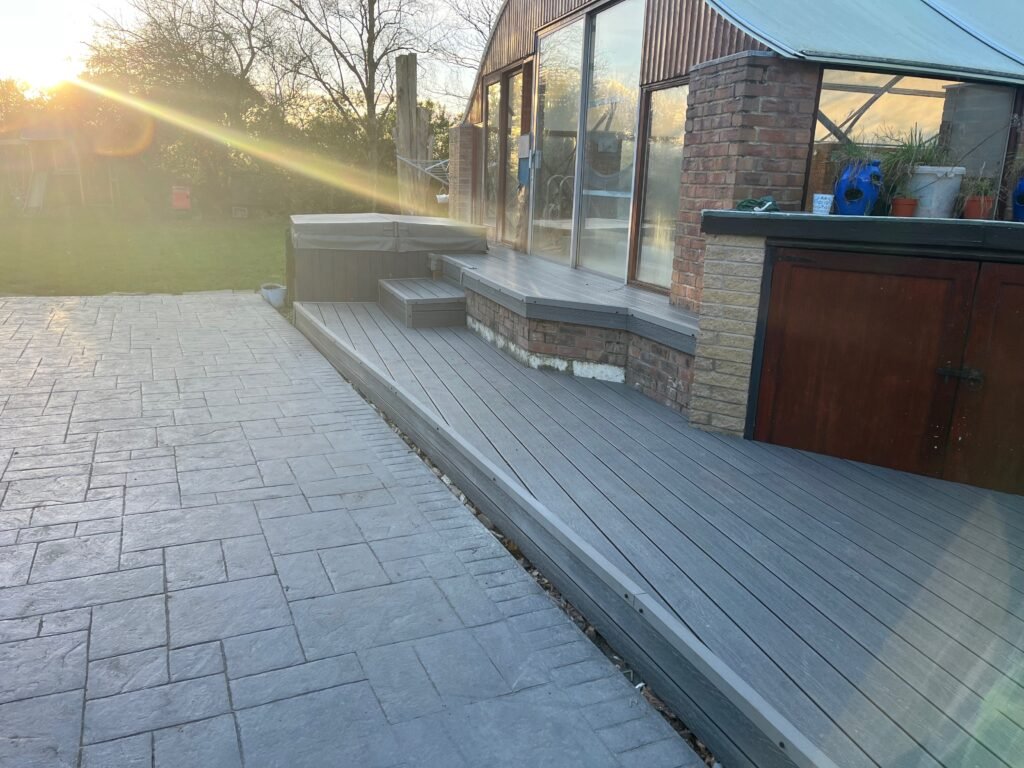
What a beautiful transformation in Birkenhead………..
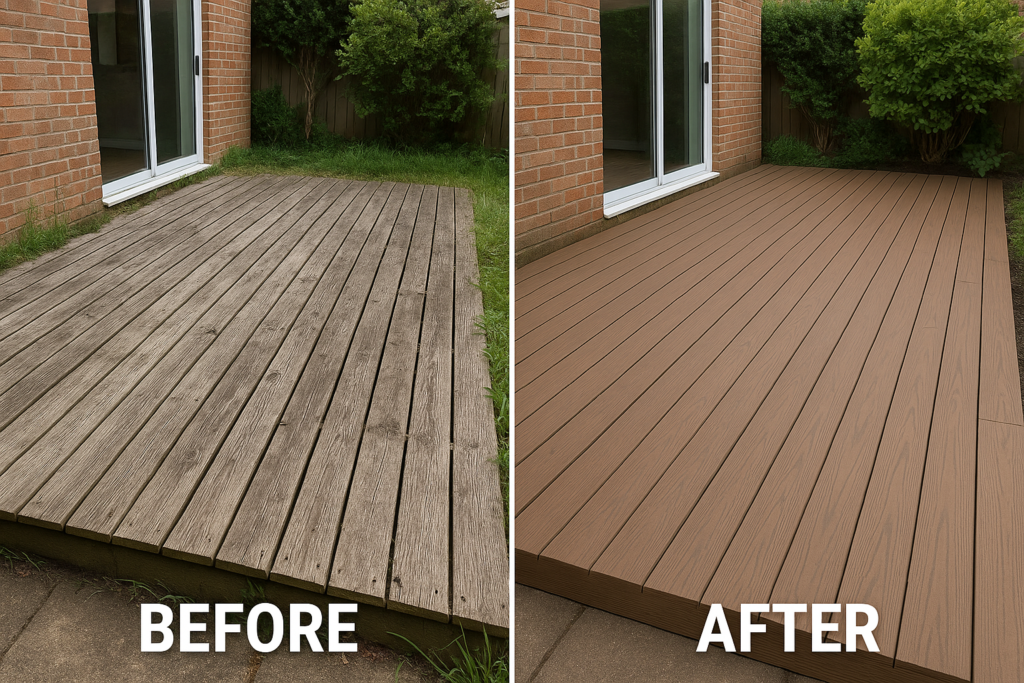
Transform Your Garden with Modern, Low-Maintenance Decking
A well-designed deck can completely change the way you use your garden. It creates a comfortable place for relaxing, entertaining, dining outdoors, or enjoying your garden throughout the year. For homeowners looking for a modern alternative to traditional timber, composite decking in Birkenhead offers an attractive combination of style, durability and reduced maintenance.
Composite decking is designed to provide the appearance of timber without many of the problems associated with ordinary wooden boards. It does not need regular staining, painting or oiling, and quality products resist moisture, fading, staining and everyday wear. That makes composite decking a practical choice for gardens across Birkenhead, where outdoor surfaces need to cope with rain, changing temperatures and long periods of damp weather.
Whether you are planning a small seating area, a large entertaining deck, steps leading into the garden, or a complete garden makeover with artificial grass and paving, composite decking can be tailored to suit the available space.
What Is Composite Decking?
Composite decking is an engineered material usually made from a blend of wood fibres and recycled or synthetic plastics. These materials are combined and formed into boards designed to reproduce the appearance and texture of natural timber.
Modern composite boards are available in a wide choice of colours, finishes and profiles. Homeowners can choose traditional brown and oak shades, contemporary greys, darker charcoal tones and realistic wood-effect finishes.
Some boards are manufactured with a protective outer shell and are known as capped composite decking. This protective layer is designed to improve resistance to staining, moisture and colour fading, making capped decking particularly suitable for busy family gardens and outdoor entertaining areas.
Not all composite decking is the same. Board quality, construction, surface finish, warranty and installation requirements can vary considerably between manufacturers. Choosing a suitable product is therefore just as important as choosing the installer.
Why Choose Composite Decking in Birkenhead?
Birkenhead has a wide range of properties, from traditional terraced and semi-detached homes to larger family houses and modern developments. Gardens vary just as much, from compact yards to larger lawns and multi-level outdoor spaces.
Composite decking works well in these different settings because it is adaptable. In a smaller garden, it can create a defined seating area without dominating the space. In a larger garden, it can provide a substantial entertaining zone outside patio or bi-fold doors. Raised decking can also help manage changes in ground level and create a smoother transition between the house and garden.
The local climate is another consideration. Timber decking is continually exposed to moisture, sunlight and temperature changes. Over time, wooden boards may require cleaning, staining and treatment to keep them looking their best.
Composite decking is designed to reduce that maintenance burden. A quality composite deck generally requires routine cleaning rather than regular painting or staining. For homeowners who want an attractive garden without adding another major maintenance job to the yearly list, this is a significant advantage.
Composite Decking Versus Timber
Traditional timber decking remains popular and can provide excellent results when properly installed and maintained. It often has a lower initial material cost and offers the character of real wood.
However, timber requires ongoing care. Depending on the type of wood and exposure, a timber deck may need regular cleaning, oiling, staining or painting. Boards can also be affected by splitting, warping, rot or surface deterioration if maintenance is neglected.
Composite decking generally costs more initially, but it is designed to reduce many of those ongoing requirements. There is no need to stain or paint the boards, and modern capped products can offer strong resistance to moisture and everyday staining.
The right choice depends on your priorities. If the lowest possible upfront cost is the main concern, timber may still be appropriate. If reduced maintenance, long-term appearance and a contemporary finish are more important, composite decking can offer excellent value.
A Modern Finish for Birkenhead Gardens
Modern composite decking can include deep wood-grain textures, multi-tonal colours and natural-looking surfaces. Grey boards are popular for contemporary gardens and work well alongside porcelain paving, rendered walls and modern fencing. Brown and oak-effect boards create a warmer appearance, while charcoal can provide a striking contrast against lighter paving or artificial grass.
Whenever possible, view physical samples in natural daylight. A board can look quite different when installed across a large area compared with a photograph or computer screen.
Composite Decking and Artificial Grass
Composite decking and artificial grass are an effective combination for modern garden design.
The decking can provide a stable area for tables, chairs, barbecues and outdoor seating, while artificial grass creates a softer area for children, pets or general garden use. Using both surfaces can also help divide a garden into useful zones.
For example, a deck immediately outside the house can form the main entertaining area, with steps leading down to an artificial lawn. Alternatively, a deck can be positioned at the far end of the garden to create a separate seating or sun area.
The transition between materials is important. Clean edging, accurate levels and careful colour selection help the finished garden look properly planned. Composite decking can also work well alongside porcelain paving, decorative stone, raised beds, fencing and garden rooms.
Ground Preparation Matters
The visible boards are important, but what sits underneath them matters just as much.
A composite decking installation should begin with an assessment of ground conditions, levels and drainage. If the area suffers from standing water or unstable ground, these issues should be addressed before construction begins. Covering a drainage problem with decking does not solve it.
Depending on the site, preparation may involve excavation, levelling, creating suitable support points or improving drainage. The subframe must then provide the correct support for the decking boards.
Manufacturers specify maximum joist spacing, and those instructions should be followed carefully. If joists are spaced too far apart, boards may flex or perform poorly. The structure should also provide sufficient airflow and allow rainwater to drain rather than becoming trapped underneath.
Choosing the Right Subframe
Several types of subframe can be used beneath composite decking.
Treated timber is commonly used because it is familiar and relatively cost-effective. Composite joists may be appropriate for some low-level installations where they can be adequately supported. Aluminium subframes are increasingly popular for premium installations because they provide excellent dimensional stability and resistance to rot.
The best solution depends on the design, height, ground conditions and expected loading of the deck.
A good quotation should therefore explain more than the brand and colour of the visible boards. Homeowners should also understand how the structure beneath them will be built.
Drainage, Ventilation and Board Spacing
Good drainage is particularly important for decking installations in Birkenhead and across Wirral.
Rainwater should be able to move away from the deck efficiently. Boards must be installed with the correct spacing, and the subframe should not create areas where water becomes permanently trapped.
Composite decking expands and contracts as temperatures change, so appropriate gaps need to be left around boards, walls, edging and other fixed structures. These details may appear small, but they have a major influence on long-term performance.
Manufacturer installation instructions should always be followed because different products can have different spacing and fixing requirements.
Steps, Edges and Finishing Details
Finishing details can make the difference between an average deck and a professional-looking installation.
Decking may require fascia boards around exposed edges, neatly finished steps, corner trims or breaker boards depending on the system. Hidden fixing systems are commonly used with composite decking, sitting between the boards instead of through the visible surface.
Steps should be carefully planned to provide safe and comfortable access, particularly where the deck connects different garden levels. If lighting is being incorporated, cables and fittings should be considered during construction rather than added later.
Deck lighting around steps, edges or seating areas can make the space more useful during evenings while adding a high-quality finishing touch.
Planning Your Composite Decking Project
A successful decking project starts with careful planning.
Consider how you intend to use the area. A deck designed for a couple of chairs and a small table has very different requirements from a large entertainment area supporting dining furniture, a barbecue and numerous guests.
Think about sunlight, access from the house, privacy and views into the garden. Existing garden levels should also influence the design.
Where possible, the deck should feel like a natural extension of the property rather than an isolated platform. For raised decking, planning and safety considerations may also need to be taken into account, particularly around height, boundaries or listed properties.
Composite Decking Costs in Birkenhead
The cost of composite decking varies according to the size and complexity of the installation.
The price of the boards is only one part of the project. Ground preparation, waste removal, subframe materials, fixings, fascia boards, steps and labour all affect the final quotation.
A simple low-level rectangular deck will generally cost less than a raised multi-level deck with several steps and detailed edging. Premium capped boards also cost more than entry-level composite products.
When comparing quotations, check what is actually included. A lower price may involve different subframe materials, cheaper boards or fewer finishing details.
The best value is not necessarily the lowest price, particularly for something expected to remain in place for many years.
Composite Decking Across Birkenhead
Composite decking can suit homes throughout Birkenhead and nearby areas, including Oxton, Prenton, Claughton, Tranmere, Rock Ferry and Noctorum.
Every garden is different. Some properties require a compact decking area to make better use of a small outdoor space. Others have room for larger decks incorporating dining areas, outdoor sofas or connections to garden rooms.
Period properties may suit warmer timber-effect finishes, while newer homes can work particularly well with contemporary grey or charcoal designs.
The aim should always be to choose a deck that complements the property and meets the practical needs of the people using it.
Why Professional Installation Matters
Composite decking is a precision product. Boards need to be supported, spaced and fixed according to manufacturer requirements.
A professional installation should account for thermal movement, drainage, airflow, joist spacing and finishing details from the beginning. The installer should also understand how the deck interacts with doors, walls, paving, lawns and existing drainage.
This becomes particularly important when composite decking forms part of a complete garden renovation. When the groundwork, subframe and visible decking are planned together, the finished result should look cleaner and perform better over the long term.
Composite Decking Birkenhead: A Practical Choice for Modern Gardens
Composite decking offers Birkenhead homeowners a modern way to create useful outdoor living space without taking on the regular maintenance associated with traditional wooden decking.
With a wide range of colours and textures, it can complement traditional houses, contemporary homes and complete garden redesigns. Its resistance to moisture and everyday wear makes it particularly attractive in the North West, while the ability to combine it with artificial grass, paving, garden rooms and other landscaping gives homeowners plenty of design flexibility.
The most important factor is to think beyond the visible boards. A long-lasting composite deck depends on correct ground preparation, effective drainage, a strong subframe and careful installation.
For anyone researching composite decking in Birkenhead, the best starting point is to consider how the garden will actually be used. Think about seating, access, sunlight, drainage, levels and maintenance. From there, the decking can be designed around the property rather than forcing the garden to fit a standard layout.
A well-planned composite deck can become one of the most useful areas of the home: somewhere to relax after work, enjoy summer evenings, entertain family and friends, or simply make better use of the garden throughout the year.
With the right design, materials and installation, composite decking can provide a clean, contemporary and practical addition to homes across Birkenhead for many years to come.
What Is Composite Decking?
Composite decking is an engineered material usually made from a blend of wood fibres and recycled or synthetic plastics. These materials are combined and formed into boards designed to reproduce the appearance and texture of natural timber.
Modern composite boards are available in a wide choice of colours, finishes and profiles. Homeowners can choose traditional brown and oak shades, contemporary greys, darker charcoal tones and realistic wood-effect finishes.
Some boards are manufactured with a protective outer shell and are known as capped composite decking. This protective layer is designed to improve resistance to staining, moisture and colour fading, making capped decking particularly suitable for busy family gardens and outdoor entertaining areas.
Not all composite decking is the same. Board quality, construction, surface finish, warranty and installation requirements can vary considerably between manufacturers. Choosing a suitable product is therefore just as important as choosing the installer.
Why Choose Composite Decking in Birkenhead?
Birkenhead has a wide range of properties, from traditional terraced and semi-detached homes to larger family houses and modern developments. Gardens vary just as much, from compact yards to larger lawns and multi-level outdoor spaces.
Composite decking works well in these different settings because it is adaptable. In a smaller garden, it can create a defined seating area without dominating the space. In a larger garden, it can provide a substantial entertaining zone outside patio or bi-fold doors. Raised decking can also help manage changes in ground level and create a smoother transition between the house and garden.
The local climate is another consideration. Timber decking is continually exposed to moisture, sunlight and temperature changes. Over time, wooden boards may require cleaning, staining and treatment to keep them looking their best.
Composite decking is designed to reduce that maintenance burden. A quality composite deck generally requires routine cleaning rather than regular painting or staining. For homeowners who want an attractive garden without adding another major maintenance job to the yearly list, this is a significant advantage.
Composite Decking Versus Timber
Traditional timber decking remains popular and can provide excellent results when properly installed and maintained. It often has a lower initial material cost and offers the character of real wood.
However, timber requires ongoing care. Depending on the type of wood and exposure, a timber deck may need regular cleaning, oiling, staining or painting. Boards can also be affected by splitting, warping, rot or surface deterioration if maintenance is neglected.
Composite decking generally costs more initially, but it is designed to reduce many of those ongoing requirements. There is no need to stain or paint the boards, and modern capped products can offer strong resistance to moisture and everyday staining.
The right choice depends on your priorities. If the lowest possible upfront cost is the main concern, timber may still be appropriate. If reduced maintenance, long-term appearance and a contemporary finish are more important, composite decking can offer excellent value.
A Modern Finish for Birkenhead Gardens
Modern composite decking can include deep wood-grain textures, multi-tonal colours and natural-looking surfaces. Grey boards are popular for contemporary gardens and work well alongside porcelain paving, rendered walls and modern fencing. Brown and oak-effect boards create a warmer appearance, while charcoal can provide a striking contrast against lighter paving or artificial grass.
Whenever possible, view physical samples in natural daylight. A board can look quite different when installed across a large area compared with a photograph or computer screen.
Composite Decking and Artificial Grass
Composite decking and artificial grass are an effective combination for modern garden design.
The decking can provide a stable area for tables, chairs, barbecues and outdoor seating, while artificial grass creates a softer area for children, pets or general garden use. Using both surfaces can also help divide a garden into useful zones.
For example, a deck immediately outside the house can form the main entertaining area, with steps leading down to an artificial lawn. Alternatively, a deck can be positioned at the far end of the garden to create a separate seating or sun area.
The transition between materials is important. Clean edging, accurate levels and careful colour selection help the finished garden look properly planned. Composite decking can also work well alongside porcelain paving, decorative stone, raised beds, fencing and garden rooms.
Ground Preparation Matters
The visible boards are important, but what sits underneath them matters just as much.
A composite decking installation should begin with an assessment of ground conditions, levels and drainage. If the area suffers from standing water or unstable ground, these issues should be addressed before construction begins. Covering a drainage problem with decking does not solve it.
Depending on the site, preparation may involve excavation, levelling, creating suitable support points or improving drainage. The subframe must then provide the correct support for the decking boards.
Manufacturers specify maximum joist spacing, and those instructions should be followed carefully. If joists are spaced too far apart, boards may flex or perform poorly. The structure should also provide sufficient airflow and allow rainwater to drain rather than becoming trapped underneath.
Choosing the Right Subframe
Several types of subframe can be used beneath composite decking.
Treated timber is commonly used because it is familiar and relatively cost-effective. Composite joists may be appropriate for some low-level installations where they can be adequately supported. Aluminium subframes are increasingly popular for premium installations because they provide excellent dimensional stability and resistance to rot.
The best solution depends on the design, height, ground conditions and expected loading of the deck.
A good quotation should therefore explain more than the brand and colour of the visible boards. Homeowners should also understand how the structure beneath them will be built.
Drainage, Ventilation and Board Spacing
Good drainage is particularly important for decking installations in Birkenhead and across Wirral.
Rainwater should be able to move away from the deck efficiently. Boards must be installed with the correct spacing, and the subframe should not create areas where water becomes permanently trapped.
Composite decking expands and contracts as temperatures change, so appropriate gaps need to be left around boards, walls, edging and other fixed structures. These details may appear small, but they have a major influence on long-term performance.
Manufacturer installation instructions should always be followed because different products can have different spacing and fixing requirements.
Steps, Edges and Finishing Details
Finishing details can make the difference between an average deck and a professional-looking installation.
Decking may require fascia boards around exposed edges, neatly finished steps, corner trims or breaker boards depending on the system. Hidden fixing systems are commonly used with composite decking, sitting between the boards instead of through the visible surface.
Steps should be carefully planned to provide safe and comfortable access, particularly where the deck connects different garden levels. If lighting is being incorporated, cables and fittings should be considered during construction rather than added later.
Deck lighting around steps, edges or seating areas can make the space more useful during evenings while adding a high-quality finishing touch.
Planning Your Composite Decking Project
A successful decking project starts with careful planning.
Consider how you intend to use the area. A deck designed for a couple of chairs and a small table has very different requirements from a large entertainment area supporting dining furniture, a barbecue and numerous guests.
Think about sunlight, access from the house, privacy and views into the garden. Existing garden levels should also influence the design.
Where possible, the deck should feel like a natural extension of the property rather than an isolated platform. For raised decking, planning and safety considerations may also need to be taken into account, particularly around height, boundaries or listed properties.
Composite Decking Costs in Birkenhead
The cost of composite decking varies according to the size and complexity of the installation.
The price of the boards is only one part of the project. Ground preparation, waste removal, subframe materials, fixings, fascia boards, steps and labour all affect the final quotation.
A simple low-level rectangular deck will generally cost less than a raised multi-level deck with several steps and detailed edging. Premium capped boards also cost more than entry-level composite products.
When comparing quotations, check what is actually included. A lower price may involve different subframe materials, cheaper boards or fewer finishing details.
The best value is not necessarily the lowest price, particularly for something expected to remain in place for many years.
Composite Decking Across Birkenhead
Composite decking can suit homes throughout Birkenhead and nearby areas, including Oxton, Prenton, Claughton, Tranmere, Rock Ferry and Noctorum.
Every garden is different. Some properties require a compact decking area to make better use of a small outdoor space. Others have room for larger decks incorporating dining areas, outdoor sofas or connections to garden rooms.
Period properties may suit warmer timber-effect finishes, while newer homes can work particularly well with contemporary grey or charcoal designs.
The aim should always be to choose a deck that complements the property and meets the practical needs of the people using it.
Why Professional Installation Matters
Composite decking is a precision product. Boards need to be supported, spaced and fixed according to manufacturer requirements.
A professional installation should account for thermal movement, drainage, airflow, joist spacing and finishing details from the beginning. The installer should also understand how the deck interacts with doors, walls, paving, lawns and existing drainage.
This becomes particularly important when composite decking forms part of a complete garden renovation. When the groundwork, subframe and visible decking are planned together, the finished result should look cleaner and perform better over the long term.
Composite Decking Birkenhead: A Practical Choice for Modern Gardens
Composite decking offers Birkenhead homeowners a modern way to create useful outdoor living space without taking on the regular maintenance associated with traditional wooden decking.
With a wide range of colours and textures, it can complement traditional houses, contemporary homes and complete garden redesigns. Its resistance to moisture and everyday wear makes it particularly attractive in the North West, while the ability to combine it with artificial grass, paving, garden rooms and other landscaping gives homeowners plenty of design flexibility.
The most important factor is to think beyond the visible boards. A long-lasting composite deck depends on correct ground preparation, effective drainage, a strong subframe and careful installation.
For anyone researching composite decking in Birkenhead, the best starting point is to consider how the garden will actually be used. Think about seating, access, sunlight, drainage, levels and maintenance. From there, the decking can be designed around the property rather than forcing the garden to fit a standard layout.
A well-planned composite deck can become one of the most useful areas of the home: somewhere to relax after work, enjoy summer evenings, entertain family and friends, or simply make better use of the garden throughout the year.
With the right design, materials and installation, composite decking can provide a clean, contemporary and practical addition to homes across Birkenhead for many years to come.


