
Composite Decking Prenton – A Better Garden Without the Annual Relationship With Wood Stain
There comes a point in the life of traditional timber decking when it stops looking like an attractive garden feature and starts looking like something that should have a warning sign attached to it.
One board has turned grey. Another has started lifting. A third makes a noise when you step on it that suggests you probably shouldn’t step on it again.
This is one of the reasons composite decking in Prenton has become such a popular choice for homeowners who want a smart, practical outdoor space without spending every spring sanding, staining and negotiating with damp pieces of timber.
Composite decking can be used for seating areas, dining spaces, garden rooms, raised terraces, family gardens and complete landscaping projects. It provides the attractive appearance of decking while requiring considerably less maintenance than traditional wood.
And, perhaps most importantly, it gives you somewhere proper to put the garden furniture instead of slowly watching its legs disappear into the lawn.
What Is Composite Decking and What is it made from?
Composite decking is an engineered decking material generally made using a mixture of wood fibres and plastic materials.
The idea is to produce a board that provides the attractive appearance of timber while reducing many of the maintenance problems associated with natural wood.
Depending on the product, composite decking can offer excellent resistance to:
- Rot
- Moisture
- Splitting
- Splintering
- Insect damage
- Everyday weathering
Unlike traditional timber decking, composite boards don’t normally need regular staining, painting or oiling.
That alone can make composite decking particularly attractive for busy homeowners.
Why Choose Composite Decking Wirral in Prenton?
Prenton gardens come in all shapes and sizes, from smaller rear gardens to larger landscaped spaces.
We have a time served professional fitting team with vast experience.
Composite decking can work well in both.
It can be used to create:
- Outdoor dining areas
- Garden seating spaces
- BBQ areas
- Garden room entrances
- Raised terraces
- Hot tub surrounds
- Children’s seating areas
- Dog-friendly garden zones
- Walkways
- Low-maintenance landscaped gardens
It can also help transform awkward or unused areas into practical spaces.
That patch beside the conservatory where nothing grows?
Decking.
The strange corner behind the extension?
Decking.
The area where you’ve been storing three broken plant pots and a chair nobody remembers buying?
Potentially also decking.
The Biggest Benefit: Less Maintenance
Timber decking can look fantastic when it is freshly installed.
Unfortunately, timber doesn’t stay freshly installed.
Rain, sunlight, moisture and general British weather gradually take their toll.
Keeping wooden decking looking good may involve:
- Cleaning
- Sanding
- Staining
- Painting
- Oiling
- Replacing damaged boards
- Treating the timber
Composite decking is much less demanding.
Routine care will normally involve:
- Sweeping away leaves
- Washing the surface occasionally
- Cleaning spills
- Keeping gaps clear
- Maintaining good drainage
In other words, you still need to look after it, but you probably won’t need to dedicate an entire Bank Holiday weekend to it.
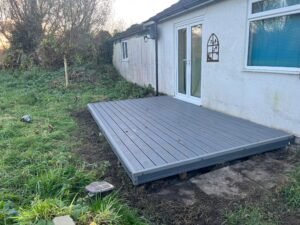
Composite Decking vs Timber Decking
Both have advantages, but they suit different homeowners.
Timber Decking
Traditional timber offers a natural appearance and can be relatively inexpensive initially.
Advantages include:
- Natural wood
- Traditional appearance
- Can be stained different colours
- Familiar material
However, timber can also:
- Require regular treatment
- Splinter
- Warp
- Crack
- Rot
- Become slippery when poorly maintained
Composite Decking
Composite decking is usually chosen for its durability and lower maintenance requirements.
Advantages include:
- No regular staining
- No regular painting
- Reduced risk of splinters
- Resistance to rot
- Wide choice of colours
- Consistent appearance
- Suitable for modern landscaping
- Easy routine cleaning
If you genuinely enjoy sanding wooden decking, timber remains an option.
If you would rather spend that time doing virtually anything else, composite starts to look very appealing.
Composite Decking for Outdoor Dining
One of the best uses for composite decking is creating an outdoor dining area.
A level deck gives you a practical surface for:
- Dining tables
- Chairs
- BBQs
- Outdoor kitchens
- Planters
- Parasols
- Garden lighting
Positioning the decking near the house can also make entertaining easier.
Nobody enjoys carrying six plates, a bowl of salad and a tray of drinks across wet grass while pretending everything is under control.
A properly positioned deck solves that problem.
Composite Decking Around Garden Rooms
Garden rooms are increasingly popular in Prenton and across Wirral.
They may be used as:
- Home offices
- Gyms
- Bars
- Games rooms
- Hobby spaces
- Summerhouses
- Studios
Composite decking can help connect a garden room to the surrounding garden.
It can create:
- An entrance platform
- Outdoor seating
- Steps
- A terrace
- A walkway
- Space for planters
Without landscaping, a garden room can sometimes look like a very expensive shed waiting for further instructions.
A well-designed deck helps it look like part of the garden.
Composite Decking and Artificial Grass
Composite decking works particularly well alongside artificial grass.
The decking can provide the seating and dining area, while artificial grass creates the softer lawn section.
A typical low-maintenance garden might include:
Composite decking near the house
Artificial grass through the centre
Decorative stone or planting around the edges
This combination is particularly useful for:
- Family gardens
- Dog-friendly gardens
- Small gardens
- Modern landscaping
- Low-maintenance outdoor spaces
Different materials help create clearly defined garden zones.
Composite Decking and Porcelain Paving
Composite decking can also be combined with porcelain paving.
For example:
- Porcelain patio for dining
- Composite decking for lounge seating
- Artificial grass for the main lawn
- Decorative stone around planting
Using several materials can make a garden feel more interesting and professionally designed.
The trick is to have a plan.
Installing every outdoor material you like at once can make the garden look less like Chelsea Flower Show and more like the display area outside a builders’ merchant.
Choosing the Right Colour
Modern composite decking comes in many colours.
Popular options include:
- Grey
- Charcoal
- Anthracite
- Light oak
- Walnut
- Brown
- Dark wood tones
- Natural wood-effect finishes
Grey Composite Decking
Grey and charcoal finishes can work particularly well with:
- Modern extensions
- Anthracite doors and windows
- Contemporary fencing
- Porcelain paving
- Garden rooms
Wood-Effect Composite Decking
Natural brown tones can complement:
- Traditional brick properties
- Timber fencing
- Established gardens
- Natural planting
- Older houses
The best approach is to view samples outdoors.
A decking colour under showroom lighting can look completely different in a Prenton garden at four o’clock on a cloudy afternoon.
Composite Decking for Small Gardens
Small gardens often benefit from clearly defined areas.
A compact composite deck can create a designated seating or dining space without overwhelming the garden.
For example, you might install decking outside patio doors with enough room for:
- A small table
- Four chairs
- Planters
- A BBQ
The rest of the garden can remain lawn, artificial grass or planting.
You don’t need an enormous deck to make a significant difference.
Composite Decking for Larger Gardens
Larger Prenton gardens offer more opportunities.
You could create:
- A dining deck beside the house
- A second seating area further down the garden
- Decking around a garden room
- A hot tub area
- A raised terrace
- A walkway
Different levels can also create more visual interest.
A large garden doesn’t necessarily need one giant rectangle of decking.
Sometimes several smaller purposeful areas work better.
Raised Composite Decking
Raised decking is particularly useful where gardens have changing levels.
It can create a level platform where the ground slopes or where patio doors sit higher than the lawn.
Raised decking may incorporate:
- Steps
- Handrails
- Balustrades
- Fascia boards
- Lighting
- Built-in seating
Structural design becomes especially important with raised decking.
A beautiful board fitted to an inadequate frame is still an inadequate deck.
The Subframe: The Important Bit Nobody Photographs
When people choose decking, they naturally concentrate on the boards.
Colour. Texture. Finish.
Installers tend to think about what’s underneath.
The subframe supports the entire deck, so correct construction is essential.
A professional installation should consider:
- Ground preparation
- Drainage
- Joist spacing
- Ventilation
- Board expansion
- Fixing systems
- Load
- Levels
- Manufacturer requirements
The subframe may not feature heavily in the finished photographs, but it is one of the most important parts of the project.
It is rather like foundations on a house.
Nobody invites friends around to admire them.
Everyone notices if they were done badly.
Composite Decking for Family Gardens
Composite decking can provide a very useful surface in a family garden.
It can create somewhere for:
- Outdoor meals
- Children’s tables
- Garden furniture
- BBQs
- Parties
- Relaxing
Many composite products also reduce the risk of splinters compared with ageing timber boards.
Good maintenance is still important, particularly keeping the surface clean and free from leaves or algae.
Composite Decking for Dog-Friendly Gardens
Dogs tend not to care very much about landscaping trends.
Their requirements are more direct.
Somewhere to run.
Somewhere to sleep.
And somewhere completely inappropriate to dig.
Composite decking can work well within a dog-friendly garden because it provides a practical hard surface near the house.
It can be paired with artificial grass to create a garden that is relatively easy to manage.
Is Composite Decking Slippery?
Any outdoor surface can become slippery if it is dirty, wet or covered with algae.
Many composite boards have textured surfaces designed to improve grip.
However, proper installation and maintenance are still important.
Keep the surface clean, remove leaves and make sure water can drain properly.
No decking manufacturer has yet invented a product capable of defeating a year’s worth of leaves, moss and neglect.
Does Composite Decking Get Hot?
Dark-coloured outdoor surfaces can become warm in direct sunlight.
Composite decking is no exception.
If your garden receives a lot of strong sun, lighter board colours may be worth considering.
Think about:
- Garden orientation
- Shade
- Children
- Pets
- How the decking will be used
Colour choice isn’t purely about appearance.
Is Composite Decking Maintenance-Free?
Not quite.
The better description is low maintenance.
Composite decking still needs occasional cleaning.
You should:
- Sweep debris away
- Clean spills
- Remove leaves
- Wash the surface when necessary
- Follow the manufacturer’s instructions
The difference is that you’re generally cleaning rather than repeatedly painting and treating.
Typical Composite Decking Installation Process
Every garden is different, but installation usually involves several stages.
1. Site Survey
The area is measured and existing levels are checked.
2. Design
The deck size, board direction, edges and steps are planned.
3. Ground Preparation
Vegetation or unsuitable existing surfaces may be removed.
4. Subframe Installation
A suitable supporting structure is built.
5. Decking Boards
Composite boards are installed using the correct spacing and fixing system.
6. Edges and Steps
Trims, fascia boards and steps are completed.
7. Final Inspection
The installation is checked for levels, drainage and finishing.
Common Decking Planning Mistakes
Making It Too Small
People often underestimate how much room garden furniture actually needs.
Remember that chairs need space to pull out.
Forgetting the Sun
Your perfect breakfast deck may spend the entire morning in shade.
Check first.
Forgetting Drainage
Rainwater still needs somewhere to go.
And this is Prenton, not southern Spain.
Ignoring Access
Think about how people naturally move from the house into the garden.
Choosing Colour From a Photograph
Get samples whenever possible.
Forgetting About Furniture
Decide roughly what will go on the decking before determining its dimensions.
Composite Decking Ideas for Prenton
The Morning Coffee Deck
A small deck positioned where the morning sun reaches.
Requirements:
- Chair
- Table
- Coffee
Everything else is optional.
The Entertaining Deck
A larger area for:
- Dining table
- BBQ
- Outdoor seating
- Lighting
The Garden Room Terrace
Ideal around an office, bar or summerhouse.
The Family Deck
Decking beside artificial grass provides separate adult and children’s areas.
The Evening Deck
Positioned where the final sunlight reaches the garden.
The Hot Tub Deck
A dedicated area around a hot tub, subject to proper structural planning.
The Escape Deck
Two comfortable chairs at the quietest end of the garden.
Phone optional.
Can Composite Decking Improve Your Garden?
Absolutely.
It can take an area that is currently:
- Muddy
- Uneven
- Unused
- Difficult to furnish
- Visually unattractive
…and turn it into a defined outdoor space.
Perhaps the biggest advantage isn’t the decking itself.
It is what the decking allows you to do with the garden.
Composite Decking Installation in Prenton
A professionally designed composite decking installation can suit both modern and traditional properties in Prenton.
Whether you want:
- A small garden seating area
- A family entertaining space
- Decking around a garden room
- Raised decking
- A complete low-maintenance garden
the layout can be designed around your property and how you actually use your outdoor space.
Why Professional Installation Matters
Composite decking needs to be installed according to the requirements of the particular system being used.
Correct installation may involve specific requirements for:
- Joist spacing
- Expansion gaps
- Ventilation
- Fixings
- Drainage
- Supporting structures
Professional installation helps ensure the finished deck looks good and performs properly over the long term.
Because there’s not much point buying low-maintenance decking if the person fitting it creates high-maintenance problems.
Get a Quote for Composite Decking in Prenton
If you are considering composite decking in Prenton, we can help create a practical outdoor space designed around your garden.
Whether you’re replacing old wooden decking, improving an unused area or planning a complete garden makeover, composite decking can provide an attractive and durable solution with considerably less maintenance than traditional timber.
Why Choose Composite Decking?
- Low maintenance
- No annual staining
- No regular painting
- Resistant to rot
- Reduced splinter risk
- Wide choice of colours
- Modern appearance
- Suitable for family gardens
- Works well with artificial grass
- Excellent around garden rooms
- Ideal for dining and seating
- Suitable for raised areas
- Professional installation available in Prenton
Your garden doesn’t necessarily need more work.
It might simply need somewhere better to sit while you avoid doing the work.
Contact us for a free composite decking quote in Prenton.


