
Composite Decking Bromborough and Eastham
Modern, Low-Maintenance Decking for Gardens Across Bromborough and Eastham
Composite decking on the Wirral has become an increasingly popular choice for homeowners who want to create a smart, practical outdoor living area without the regular upkeep associated with traditional timber decking.
For properties in Bromborough and Eastham, composite decking can work particularly well because it provides a clean, modern finish while coping with the changing weather conditions experienced across Wirral. Whether you are improving a compact rear garden, creating a seating area outside patio doors, building a raised deck, or combining decking with artificial grass and paving, composite boards offer a flexible solution and we have a time served professional installation team.
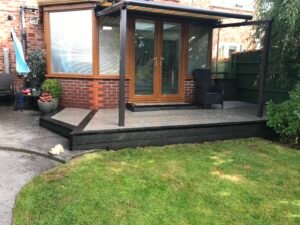
A properly designed deck can completely change how a garden is used. Instead of having an awkward or underused area, homeowners can create a defined space for:
- outdoor dining;
- family seating;
- barbecues;
- garden furniture;
- entertaining;
- relaxing in the evening;
- connecting the house with the rest of the garden.
Composite decking is available in a wide range of colours, finishes and board styles, making it suitable for both traditional and contemporary properties.
What Is Composite Decking?
Composite decking is an engineered material usually manufactured using a combination of wood fibres and plastics.
These materials are blended together and formed into decking boards. The aim is to create a surface that has the appearance and texture of timber while reducing many of the maintenance problems associated with natural wood.
Depending on the manufacturer, composite decking may contain recycled materials, wood flour, synthetic polymers and protective additives.
Modern boards can be manufactured in several different ways.
Common types include:
- hollow composite decking;
- solid composite decking;
- capped composite decking;
- reversible decking boards;
- textured woodgrain boards;
- smooth or contemporary finishes.
Capped composite decking includes a protective outer layer around the main composite core. This additional layer can help improve resistance to staining, moisture and general wear.
For busy gardens in Bromborough and Eastham, this can be useful where the decking is regularly used for family gatherings, pets, outdoor dining or children’s play.
Why Choose Composite Decking in Bromborough and Eastham?
One of the main attractions of composite decking is the reduced maintenance requirement.
Traditional timber decking can look excellent when it is first installed, but keeping it that way can involve regular work.
Depending on the type of timber, maintenance may include:
- cleaning;
- sanding;
- staining;
- painting;
- oiling;
- replacing damaged boards;
- treating areas affected by moisture.
Composite decking is designed to reduce many of these jobs.
Routine cleaning is still required, but homeowners generally do not need to paint or stain the boards each year.
For people who want to spend more time enjoying their garden and less time maintaining it, this is one of the biggest advantages.
Composite Decking and the Wirral Climate
Outdoor surfaces in Bromborough, Eastham and the surrounding Wirral area need to cope with regular rain, damp conditions and changing temperatures.
Natural timber absorbs and releases moisture. Over time, repeated exposure to wet and dry conditions can contribute to movement, splitting and surface deterioration.
Composite decking behaves differently.
Because the boards contain plastic materials, they generally absorb less water than ordinary timber. Modern capped composite boards provide even greater surface protection.
This does not mean composite decking can simply be fitted over poorly drained ground.
A good installation still requires:
- correct groundwork;
- proper drainage;
- suitable ventilation;
- appropriate board spacing;
- a strong supporting subframe.
The visible boards may be the part homeowners notice first, but the structure underneath is equally important.
Composite Decking Versus Timber Decking
Both timber and composite decking have advantages.
Timber remains popular because it offers a natural appearance and can have a lower initial material cost.
Composite decking generally costs more at the beginning, but many homeowners choose it because of its lower maintenance requirements.
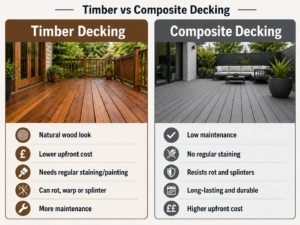
Timber decking may offer:
- a lower initial cost;
- natural wood grain;
- traditional appearance;
- easy cutting and installation;
- a wide range of timber species.
Composite decking may offer:
- reduced maintenance;
- no annual painting or staining;
- consistent appearance;
- strong resistance to moisture;
- less risk of splintering;
- a wide choice of modern colours;
- hidden fixing systems;
- good long-term appearance.
The best option depends on budget, appearance, garden use and how much maintenance the homeowner is prepared to carry out.
Composite Decking Colours and Styles
One of the reasons composite decking has become so popular is the large choice of colours now available.
Homeowners are no longer restricted to simple brown decking.
Popular choices include:
- light grey;
- silver grey;
- charcoal;
- black;
- oak;
- walnut;
- teak-effect;
- dark brown;
- multi-tonal woodgrain.
Grey composite decking works particularly well in contemporary garden designs.
It can complement:
- porcelain paving;
- modern fencing;
- rendered walls;
- artificial grass;
- garden rooms;
- outdoor kitchens;
- contemporary furniture.
Brown and oak-effect decking can work well with traditional brick properties and established gardens.
It is always worth viewing physical decking samples before making a final decision. Colours can look very different outdoors compared with photographs on a phone or computer.
Composite Decking and Artificial Grass
Composite decking and artificial grass are a popular combination for garden renovations in Bromborough and Eastham.
The two materials perform different roles.
Composite decking creates a stable surface for furniture and entertaining, while artificial grass provides a softer green area for children, pets and general garden use.
A typical garden layout might include:
- composite decking immediately outside the house;
- steps leading down from the decking;
- artificial grass through the centre of the garden;
- planting or decorative stone around the edges;
- a garden room or additional seating area at the rear.
This can create clear zones while keeping the garden practical.
Careful edging is important where artificial grass meets composite decking. Clean transitions help the finished garden look professionally designed rather than simply made up of separate materials.
Composite Decking for Raised Areas
Some properties in Bromborough and Eastham have gardens where the level outside the rear doors is different from the rest of the garden.
Decking can be particularly useful in these situations.
A raised deck can create a level outdoor seating area outside patio or bi-fold doors and then incorporate steps down to the lawn or paving.
Raised decking may also help homeowners make better use of sloping gardens.
However, raised structures require careful planning.
Important considerations include:
- structural strength;
- support posts;
- handrails where necessary;
- steps;
- drainage;
- access underneath;
- local planning requirements where applicable.
The height and design of the deck should always suit the property rather than overwhelming the garden.
The Importance of the Decking Subframe
A composite deck is only as strong as the structure underneath it.
The subframe provides support for every board and must be designed according to the manufacturer’s recommended joist spacing.
Possible subframe materials include:
- pressure-treated timber;
- composite joists;
- aluminium.
Each option has advantages.
Treated timber is commonly used because it is familiar and cost-effective. Composite joists can work well in suitable low-level applications. Aluminium is increasingly used for premium projects because it provides excellent dimensional stability and does not rot.
The correct choice depends on:
- deck height;
- ground conditions;
- board specification;
- expected loading;
- budget;
- intended lifespan.
A quality quotation should explain the proposed subframe rather than focusing only on the visible boards.
Drainage and Ground Preparation
Before any decking is installed, the ground needs to be assessed.
If an area regularly holds standing water, simply covering it with decking will not solve the underlying problem.
Poor drainage beneath a deck can contribute to:
- damp conditions;
- algae growth;
- unpleasant smells;
- deterioration of timber subframes;
- movement;
- pest problems.
Depending on the site, preparation may involve excavation, levelling, drainage improvements or the installation of suitable support points.
The decking itself also needs correct spacing so water can escape.
Composite boards expand and contract slightly as temperatures change, meaning the installation must allow for thermal movement.
Is Composite Decking Slippery?
Any outdoor surface can become slippery if leaves, algae or organic debris are allowed to build up.
Composite decking is no different.
Slip resistance varies between manufacturers and board styles.
Textured surfaces may provide improved grip compared with smooth products.
To help keep the deck safer:
- sweep away leaves regularly;
- wash the surface when needed;
- prevent moss and algae build-up;
- maintain good drainage;
- avoid allowing standing water to remain;
- follow the manufacturer’s cleaning guidance.
Homeowners concerned about slip resistance should ask to see the technical specification for the product being considered.
Composite Decking for Families
Composite decking can be a practical choice for family gardens because it creates a clean, usable hard-standing area.
It can be used for:
- garden tables;
- outdoor sofas;
- children’s furniture;
- barbecues;
- play equipment;
- storage boxes;
- planters.
Many modern composite boards are designed to reduce splintering, which can be an advantage for families where children frequently play outside.
However, darker decking can become warm during strong sunshine, so colour choice should take garden orientation into account.
Composite Decking for Dog Owners
Pet owners are also increasingly choosing composite decking.
Capped boards are generally easier to wipe and wash than untreated timber.
However, regular cleaning is still important.
For dog-friendly gardens, consider:
- good surface drainage;
- easy hose access;
- sealed or low-absorption decking;
- adequate ventilation underneath;
- simple transitions between decking and artificial grass;
- no areas where organic waste can become trapped.
When artificial grass and decking are combined, the entire area should be planned with drainage in mind.
Steps, Fascias and Finishing Details
The small details can make a major difference to how professional a composite deck looks.
Finishing options may include:
- fascia boards;
- matching steps;
- contrasting border boards;
- hidden fixings;
- corner trims;
- lighting;
- decorative edging.
Hidden fixing systems are commonly used with composite decking because the clips sit between the boards rather than through the visible surface.
This produces a cleaner finish.
Lighting can also be integrated into steps or around the edges of a deck, making the space more attractive and practical during the evening.
Composite Decking Costs in Bromborough and Eastham
The cost of composite decking varies considerably from project to project.
Factors that affect the price include:
- total deck size;
- quality of board;
- capped or uncapped construction;
- subframe material;
- ground preparation;
- number of steps;
- raised sections;
- edging and fascia boards;
- waste removal;
- access to the garden;
- lighting or additional features.
A simple rectangular ground-level deck will usually cost less than a raised multi-level installation.
When comparing quotations, homeowners should avoid looking only at the total price.
Ask what is included.
Two quotations can appear to describe the same deck while using completely different materials underneath.
Questions to Ask Before Choosing Composite Decking
Before proceeding with an installation, ask the installer:
- What decking brand will be used?
- Is the board capped?
- What warranty does the manufacturer provide?
- What subframe will be installed?
- What joist spacing will be used?
- How will rainwater drain?
- How will the edges be finished?
- Are hidden fixings included?
- Is excavation included?
- Is waste removal included?
- Are steps included in the quotation?
- How long is the installation expected to take?
A clear quotation helps avoid misunderstandings later.
Composite Decking Across Bromborough and Eastham
Gardens across Bromborough and Eastham vary enormously.
Some homeowners want a small area outside the rear doors for a table and chairs. Others want a complete garden transformation incorporating decking, artificial grass, paving, raised beds and modern fencing.
Composite decking can be adapted to suit both.
It can provide a useful solution for:
- compact rear gardens;
- large family gardens;
- sloping gardens;
- new-build properties;
- traditional houses;
- garden rooms;
- patio replacements;
- multi-level gardens.
The design should always reflect the property and the way the homeowner intends to use the outdoor space.
Composite Decking Bromborough and Eastham: A Long-Term Garden Upgrade
For homeowners considering composite decking in Bromborough and Eastham, the main attraction is the combination of appearance, practicality and reduced maintenance.
A good composite deck can create a comfortable outdoor living area that works alongside the rest of the garden rather than competing with it.
Whether the aim is to build a simple seating platform, create a raised entertaining area or form part of a complete garden makeover, careful preparation is essential.
The best results come from considering the whole system:
- ground conditions;
- drainage;
- subframe;
- decking board;
- fixing system;
- edges;
- steps;
- surrounding landscaping.
Choosing attractive boards is only the beginning.
When composite decking is properly supported, correctly spaced and professionally finished, it can provide a smart, practical outdoor surface for many years.
For properties throughout Bromborough, Eastham and the surrounding Wirral area, composite decking offers a modern alternative to timber that can help turn an underused garden into a more comfortable and enjoyable extension of the home.


