
Composite Decking Greasby, Frankby and Irby
Modern, Low-Maintenance Composite Decking for Wirral Gardens
Composite decking is becoming an increasingly popular choice for homeowners across Greasby, Frankby and Irby who want to create a stylish, practical outdoor living area without the regular maintenance associated with traditional timber decking.
A well-designed deck fitted by our professional installation team can transform how a garden is used. It can provide a comfortable seating area, a space for outdoor dining, a level platform outside patio doors, or a smart connection between the house and the rest of the garden. Composite decking is particularly well suited to modern garden makeovers because it combines a clean appearance with durability and reduced maintenance.
For properties across Greasby, Frankby and Irby, where gardens vary from compact family spaces to larger landscaped plots, composite decking can be designed to suit the size, layout and character of the property.
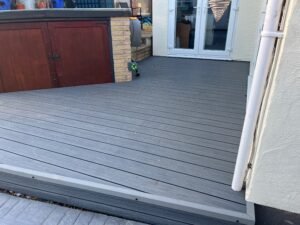
What Is Composite Decking?
Composite decking is an engineered decking material usually made from a mixture of wood fibres and plastic polymers.
The materials are blended and formed into boards designed to reproduce the appearance of timber while offering greater resistance to moisture, rot and everyday wear.
Modern composite decking is available in a wide range of colours and finishes, including:
- light grey;
- charcoal;
- oak;
- walnut;
- teak-effect;
- brown;
- multi-tonal woodgrain finishes.
Some boards are manufactured with a protective outer shell. These are often referred to as capped composite decking.
The capped surface can help improve resistance to staining, fading and moisture, making it particularly useful for busy family gardens.
Why Choose Composite Decking in Greasby, Frankby and Irby?
One of the main reasons homeowners choose composite decking is the reduced maintenance requirement.
Traditional timber decking can look excellent when first installed, but it may require regular cleaning, staining, oiling or painting to keep it looking its best.
Composite decking generally requires much less ongoing treatment.
Routine cleaning is still important, but homeowners usually do not need to spend time sanding or re-staining the deck every year.
This makes composite decking particularly attractive for customers who want a smart garden but do not want to spend large amounts of time maintaining it.
Other advantages can include:
- resistance to rot;
- reduced risk of splintering;
- consistent appearance;
- wide colour choice;
- hidden fixing systems;
- compatibility with artificial grass and paving;
- suitable for contemporary and traditional homes.
Composite Decking for Greasby Gardens
Greasby has a wide mix of family homes and established gardens, many of which are ideal for composite decking.
A deck can be installed directly outside the rear of the house to create an area for tables, chairs and outdoor furniture.
In larger gardens, decking can also be used to create a separate seating area away from the house.
For homeowners planning a complete garden makeover, composite decking can be combined with artificial grass, porcelain paving, decorative stone, modern fencing and raised planters.
Grey composite decking is particularly popular for contemporary designs, while warmer brown and oak shades can work well with more traditional properties.
Composite Decking in Frankby
Frankby is known for larger properties, mature gardens and more rural surroundings.
Composite decking can work particularly well in these settings because it allows homeowners to create practical outdoor living areas without losing the natural feel of the garden.
Brown, oak or timber-effect composite boards can blend well with established planting, trees and traditional landscaping.
For larger gardens, decking can be used to create:
- outdoor dining areas;
- barbecue spaces;
- garden seating zones;
- raised viewing areas;
- pathways between garden buildings;
- platforms around garden rooms.
The design should always complement the scale of the property and the surrounding landscape.
Composite Decking in Irby
Irby properties often have attractive gardens with plenty of potential for modern landscaping.
Composite decking can be particularly useful where homeowners want to create a clean, level outdoor area without installing a large paved patio.
It can also help where the garden slopes away from the house.
Raised decking can create a level platform outside patio or bi-fold doors, with steps leading down into the rest of the garden.
This can make the transition between indoor and outdoor space feel much more natural.
Composite Decking Versus Timber
Both composite and timber decking have advantages.
Timber usually has a lower initial material cost and provides the natural character of real wood.
However, timber requires more maintenance.
Over time, wooden decking may need cleaning, sanding, staining or replacing if boards become damaged.
Composite decking usually costs more at the beginning, but the reduced maintenance requirements can make it attractive over the longer term.
Timber decking may offer:
- lower upfront cost;
- natural wood grain;
- traditional appearance;
- easy repair and replacement.
Composite decking may offer:
- lower maintenance;
- no regular staining;
- reduced risk of rot;
- reduced splintering;
- strong moisture resistance;
- modern finishes;
- hidden fixings.
The best choice depends on budget, appearance and how much maintenance the homeowner is prepared to carry out.
The Importance of Ground Preparation
A successful decking installation begins below ground level.
Before fitting composite boards, the installer should assess the site carefully.
If the area suffers from poor drainage, standing water or unstable ground, these problems should be addressed before the deck is installed.
Simply covering a wet or uneven area with decking does not solve the underlying problem.
Ground preparation may include:
- excavation;
- removing old decking or paving;
- levelling;
- creating suitable support points;
- improving drainage;
- clearing vegetation.
Correct preparation helps create a stable base for the subframe.
Choosing the Right Subframe
The subframe is one of the most important parts of any composite decking installation.
It supports the boards and determines how strong and stable the finished deck will be.
Common subframe options include:
- pressure-treated timber;
- composite joists;
- aluminium.
The right choice depends on the size, height and design of the deck.
Aluminium is increasingly popular for premium installations because it does not rot and offers excellent dimensional stability.
Treated timber remains widely used because it is strong and cost-effective.
Whatever material is chosen, the joists must be installed at the correct spacing according to the decking manufacturer’s recommendations.
Drainage and Ventilation
Drainage is especially important in Wirral gardens.
Rainwater needs somewhere to go.
Deck boards should be installed with the correct gaps between them so water can drain through.
The area underneath the deck also needs adequate airflow.
Poor ventilation can encourage damp conditions and organic growth.
Good installation should take account of:
- drainage direction;
- board spacing;
- subframe height;
- air circulation;
- existing ground conditions.
These details are easy to overlook, but they are essential for long-term performance.
Composite Decking and Artificial Grass
Composite decking works extremely well alongside artificial grass.
The two materials perform different roles.
Decking creates a hard, stable area for furniture, while artificial grass provides a softer green surface for children, pets and everyday garden use.
A popular garden layout might include:
- composite decking outside the house;
- steps leading down;
- artificial grass through the centre of the garden;
- planting or decorative stone around the edges;
- a garden room or seating area at the rear.
Using different surfaces can make the garden feel more organised and functional.
Composite Decking for Family Gardens
Composite decking is a practical choice for family homes.
It creates a clean area for:
- outdoor tables;
- garden sofas;
- children’s furniture;
- barbecues;
- storage boxes;
- planters.
Many modern boards are designed to minimise splintering, which can be an advantage for children who regularly use the garden.
Dark composite decking can become warm in strong sunlight, so colour choice should take garden orientation into account.
Composite Decking for Dog Owners
Composite decking can also work well in pet-friendly gardens.
Capped boards are generally easier to clean than untreated timber.
For dog owners, good drainage and hygiene remain important.
Useful considerations include:
- easy hose access;
- smooth transitions between decking and artificial grass;
- no areas where waste can become trapped;
- suitable ventilation underneath;
- low-absorption decking surfaces.
A well-designed deck can form part of a practical, low-maintenance garden for both pets and their owners.
Choosing Composite Decking Installers
Homeowners should look beyond the headline price when comparing decking quotations.
A professional installer should be able to explain:
- which decking brand will be used;
- whether the board is capped;
- what warranty is included;
- what subframe will be fitted;
- how drainage will work;
- how the edges will be finished;
- whether waste removal is included;
- how expansion and movement will be allowed for.
Photographs of previous installations can also help demonstrate the quality of workmanship.
Composite Decking Greasby, Frankby and Irby
Composite decking offers homeowners across Greasby, Frankby and Irby a practical way to create attractive outdoor living space.
Whether the project involves a small seating platform, a large entertaining area, raised decking or a complete garden transformation, the quality of the preparation and installation is just as important as the decking boards themselves.
A good composite decking system should combine:
- strong groundwork;
- suitable drainage;
- a correctly constructed subframe;
- quality decking boards;
- proper board spacing;
- neat edging;
- professional finishing.
When these elements are planned together, composite decking can provide a stylish and durable garden feature that requires far less maintenance than traditional timber.
For homeowners looking to improve their outdoor space, composite decking can offer a clean, modern finish while remaining practical for everyday family life.


